

When a worksheet is worth using
Use a worksheet when more than one catalogue style is appealing and the cap description could influence daily wear. It is most useful before an enquiry, not after a decision. The point is to preserve what the catalogue actually says, identify what the photographs suggest, and mark the details that remain unknown.
Compare the underneath before choosing the look
Start with styles that meet the visual brief, then make cap details comparable across them. The browsing page for wig brand catalogues is a useful place to collect names, but each shortlisted style needs its own row. A brand name, collection label or attractive model photograph is not a substitute for a specific cap description.
Make a row when two pieces differ in the hairline shown, the part direction, the stated cap construction or the size information. It is also useful when one listing names a feature and another is silent. For example, a page for Rene of Paris wigs can be reviewed as a brand reference, while the worksheet keeps the decision tied to the individual style details that are displayed.
- Create one row for one named style, colour and listed size rather than one row for an entire brand.
- Separate what is written in the specification from what is only visible in a model image.
- Mark a blank cell as ‘confirm’ instead of filling it with an assumption from a similar wig.
Build a record that can be checked later
A short record is more dependable than a long set of impressions. Keep the product page open while you enter the row. Copy the model name as shown, note the colour shown in the image, and preserve the construction words exactly. If a page later changes, your question will still identify what you saw.
Give every cell one kind of evidence
Use the product description for stated construction, and use images only for visible placement or styling. Do not infer a full cap from a close hairline image. Likewise, a lifestyle photograph can help you note whether the front is exposed, but it cannot establish the cap material, the attachment method or the amount of stretch.
Keep cost conversations in a different column from cap observations. A catalogue price, a quote and the cost of a different construction are not interchangeable. When budget becomes relevant, review wig prices in Hong Kong separately and ask for an up-to-date comparison rather than treating a worksheet as a quotation.
| Worksheet field | Record from the page | Question it prepares |
|---|---|---|
| Style identifier | Brand, model name, colour and displayed size | Are we discussing this exact listed version? |
| Front edge | Lace-front wording, fringe or exposed forehead image | What does the stated front construction cover? |
| Top and part | Mono top, mono part, crown or no stated feature | Where is the part designed to sit, and can it move? |
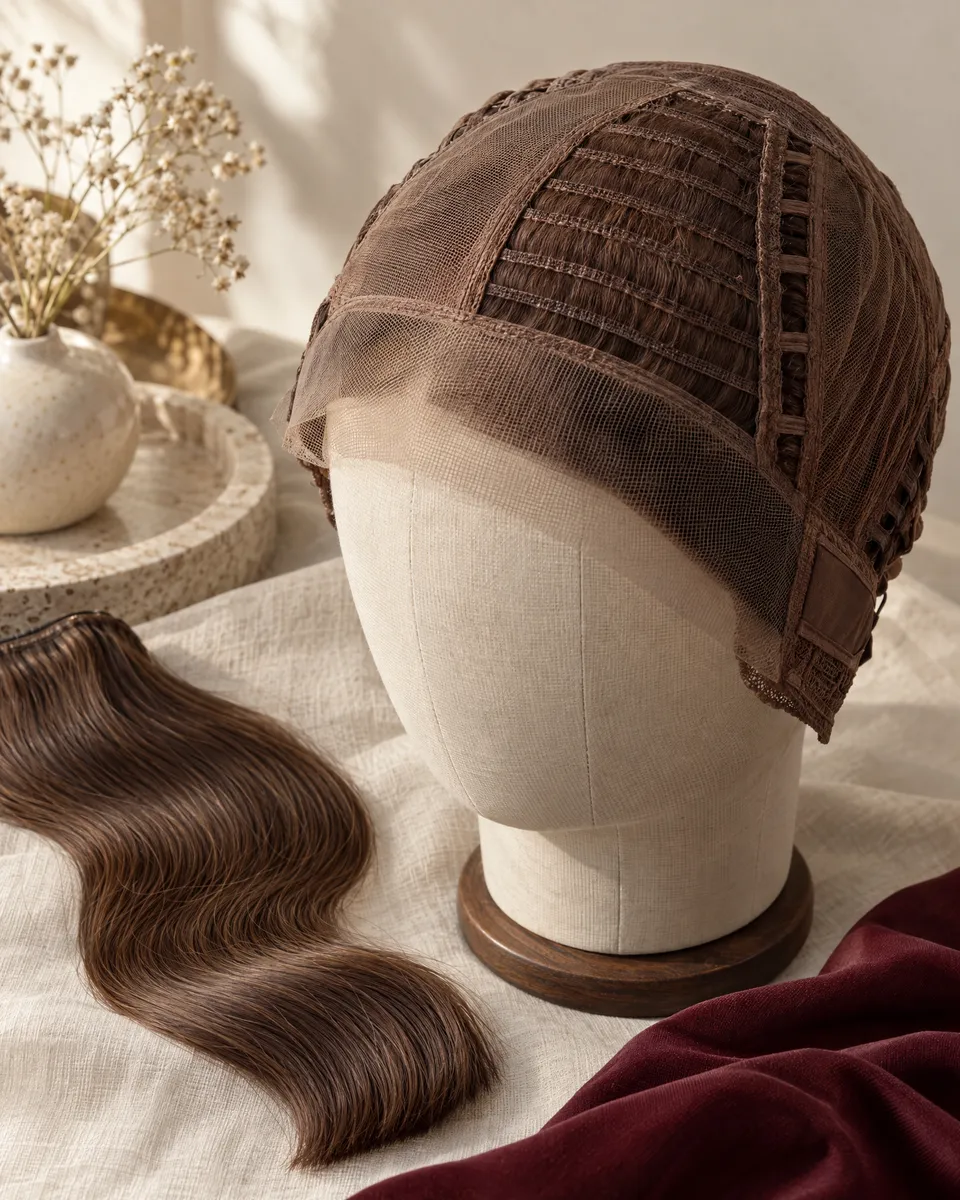
| Cap interior | Wefts, open areas, hand-tied wording or no interior photo | Which parts are wefted or hand-tied on this style? |
| Fit evidence | Size range, rear tabs or ear-tab image if shown | What adjustment is provided for this cap? |
| Open point | A blank or a feature not defined on the listing | Can this detail be confirmed before selection? |
Read cap terms by location and scope
Cap terminology becomes useful only when the worksheet records where the feature sits and how much of the cap it covers. A feature at the front solves a different visual question from a feature at the part. Avoid treating any one label as a complete description of the whole base.
Ask what area the label describes
An official Jon Renau selection guide links cap construction to hairline exposure, desired part movement, crown volume and the softness of base materials. Its prompts are practical worksheet headings: whether hair is worn back, whether the part changes and whether a natural growth appearance matters. See Jon Renau’s beginner’s guide to wig buying for the maker’s explanation of those decision points.
The labels ‘capless’, ‘open cap’ and ‘wefted’ are often used around airflow, but they should still be read from the exact product description. A check of an open wefted wig cap can help frame the construction question. Put ‘open wefted’ in the interior field, not in the front-edge or part field, unless the listing explicitly describes those areas too.
- For a lace-front claim, record the stated front area and whether the chosen hairstyle exposes it.
- For a monofilament claim, record whether it is a part, crown or larger top area.
- For hand-tied wording, ask which zones use it rather than assuming the whole cap does.
Use photographs as visual clues, not cap proof
Photographs are valuable because they reveal the intended styling direction. They are weak evidence for hidden construction. Review images in a fixed order so a flattering colour, pose or edit does not cause you to overlook the product specification and the parts of the cap that are not shown.
Look at the front, part, crown and inside separately
First inspect the front: is the hairline covered by a fringe, swept away from the face or partly visible? Next inspect the part and crown for the intended direction and volume. Finally, look for an interior image or stated adjustment detail. Headcovers explains that lace front refers to the hairline and monofilament to the part area; a wig may have both, one or neither. Its cap-type explanation is a helpful reminder not to merge these two observations.
Colour deserves its own line. An image in a balayage wigs selection may help you describe dimensional tones you like, but it cannot verify the cap beneath a particular style. Record colour as ‘visual preference’ and construction as ‘stated specification’. This keeps a tone decision from accidentally becoming a claim about hairline or part flexibility.
| Image area | What to note | What not to conclude |
|---|---|---|
| Front hairline | Whether the style exposes the forehead | That every unseen front edge is lace |
| Part | Position and visible direction in the photograph | That the part can be moved |
| Crown | Lift, density and styling direction | That the crown uses a specific base material |
| Interior | Any clear view of wefts, tabs or mesh | That missing images mean a feature is absent |
| Colour image | Tone, root effect and contrast you prefer | That colour changes construction or fit |

Turn observations into focused enquiry questions
The best result from the worksheet is a short enquiry that another person can answer clearly. Avoid asking whether a wig is simply ‘good’ or ‘comfortable’. Instead, name the style and the exact field you recorded. This makes the answer easier to compare against the next shortlisted row.
Ask one verifiable question at a time
For fitting, ask what adjustment the named cap has and whether the displayed size needs a head measurement. Breastcancer.org’s general fitting guidance describes measuring cap size, smoothing hair or using an under-cap where relevant, adjusting rear tabs and using ear tabs to centre the wig. These are useful practical checks, not a promise that every style uses the same system; see its wig fitting guidance.
If the front edge is a priority, phrase the question around the listed construction and intended styling. If extra security is being considered, ask whether it is appropriate for that cap and how it should be used rather than presuming it is necessary. The product context for wig tape can support that conversation, but it does not prove that tape suits every lace-front or every wearer.
- ‘For this exact model, is the monofilament area a part, crown or full top?’
- ‘What feature creates the visible front edge when this style is worn away from the face?’
- ‘Which adjustment points are included, and what head measurements should I provide?’
- ‘Is there anything in the listed cap construction that needs different handling or securement?’
Keep care notes separate from cap comparisons
Care affects whether a chosen wig remains easy to wear, but it is not evidence about construction. Keep a separate care column for fibre type, maker instructions and products under consideration. This avoids applying one item’s care routine or heat guidance to a different fibre or an unspecified cap.
Match the care question to the listed fibre
A cap worksheet can record the listed fibre because it influences the next question, but it should not turn general care advice into a product claim. Jon Renau notes that traditional synthetic, heat-resistant synthetic and human hair have different maintenance considerations. Record the exact fibre wording, then request the relevant care direction for the style instead of assuming that a similar-looking wig uses the same routine.
If care products are part of the selection, ask which are suitable for the stated fibre and manufacturer instructions. The pages for wig conditioner and wig detangler spray are useful starting points for naming the type of product you mean. They should remain separate worksheet entries, because neither product category confirms a wig’s cap material, lace area or availability.

Recognise false signals and missing evidence
A disciplined worksheet makes uncertainty useful instead of frustrating. A blank cell can show exactly what needs to be asked. It can also stop a comparison from drifting into claims that a catalogue image cannot establish, such as stock status, a precise fit, comfort over time or the construction of a hidden panel.
Keep ‘not shown’ distinct from ‘not included’
Do not read an absent interior photograph as proof that a cap lacks adjustment, and do not read a perfectly styled front image as proof of a particular lace specification. The worksheet should say ‘not shown’ or ‘not stated’. That wording gives the enquiry a clear next step and prevents silence in a listing from being converted into a negative claim.
Likewise, do not use another model’s description to complete the row. Products within one brand can have different cap configurations, colours and listed sizes. Keep model names intact, retain screenshots or notes for your own reference, and ask before treating an apparent construction detail as confirmed for the exact option you prefer.
- A model photograph does not establish availability, a current quote or a guaranteed fit.
- A lace-front label does not automatically describe the part or the rest of the cap.
- A general term such as open cap needs the product’s own wording and, where needed, a direct confirmation.
- A care product category does not establish that a fibre, adhesive method or cap detail is compatible.
Finish with a compact next-enquiry checklist
Before contacting OWNSTRAND, scan each row once. You should be able to say what is visible, what is stated and what needs confirmation without reopening every catalogue page. That preparation makes it easier to discuss the trade-off that matters to you, whether it is a visible hairline, a familiar part direction, a lighter-feeling interior or a care routine you can manage.
Send only the details that move the choice forward
Bring the style name, image or link, the selected colour, any displayed size and the three most important cap questions. Add a short note about how you expect to wear the hair: fringe forward, part visible, hair behind the ears or front swept back. Those facts give context to the worksheet without pretending that a photograph has already answered the fitting question.
If several rows remain close, compare the unanswered cells rather than creating more categories. A small difference in the location of a stated feature may matter more than a long description of the style. The aim is a calmer, checkable conversation that helps you choose the next detail to confirm.
| Priority | What the worksheet captures | Why it changes the next question |
|---|---|---|
| Hairline | Visible front styling and stated lace-front wording | Clarifies whether a natural-looking exposed front matters for your chosen style |
| Part and top | Location and scope of a stated monofilament feature | Separates a preferred part appearance from a claim of full top flexibility |
| Interior | Wefts, open areas, hand-tied wording and any unseen zones | Keeps airflow and base questions tied to the actual listing |
| Fit | Displayed size information, tabs and items requiring confirmation | Prepares a specific measurement and adjustment question |
| Care | Listed fibre and product-care questions | Prevents care assumptions from being applied across different styles |
Ask OWNSTRAND on WhatsApp
Tell us the style you have in mind. We can discuss the options, quotation and arrangements before you decide.
Ask OWNSTRAND on WhatsAppBefore you choose
What should I record first in a brand-catalogue comparison worksheet for wig cap details?
Record the exact brand, model name, displayed colour and size before recording cap language. Then split the cap notes into front edge, part or top, crown, interior and fit. This order prevents a general brand description or a styled colour image from being attached to the wrong model. Any missing field should remain marked for confirmation.
Can a photograph confirm that a wig has a lace front or monofilament top?
A photograph can show how the hairline or part is styled, but it should not replace the product specification. Look for the stated feature and record its location. A lace-front feature concerns the front hairline, while monofilament wording needs its scope checked. If the listing does not state the construction, ask about the exact model rather than inferring it.
Why keep cap, price and care in different worksheet fields?
They answer different questions. Cap fields describe listed construction and the fitting questions it raises. Price needs a current, style-specific conversation. Care depends on the listed fibre and instructions. Keeping them separate helps you compare like with like and avoids assuming that one item’s cost or care approach proves anything about another item’s cap.
Further reading
- The Beginner’s Guide to Wig Buying — Jon RenauSupports the worksheet prompts connecting cap construction with exposed hairlines, part movement, crown volume, base-material softness and fibre-care considerations.
- Types of Wigs: Cap Construction — HeadcoversSupports distinguishing lace-front hairline construction from monofilament part or top construction, and checking the scope of listed cap features.
- Wigs — Breastcancer.orgSupports general practical fitting checks including measuring cap size, rear-tab adjustment and using ear tabs to centre a wig; it is not used for diagnosis or treatment advice.