
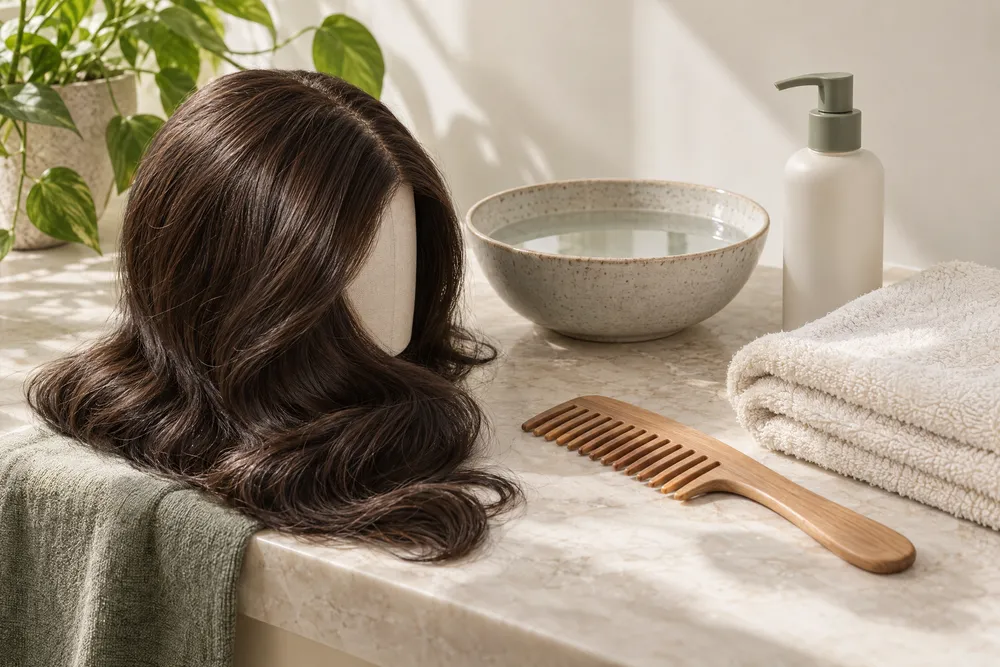
Heat friendly synthetic wig care starts with the model label
The safest starting point is a simple identification check. A general description such as “heat-friendly” is not a complete styling instruction; you need guidance that applies to the exact model in your hands.
Heat friendly synthetic wig care begins by identifying the exact model
Find the product name or model details on the packaging, tag, order information or care leaflet, then match those details to the manufacturer’s instructions. A seller’s broad category page or a video about a similar-looking wig may not describe the same fibre or construction. If the label is no longer available, do not identify the fibre by appearance alone: ask the seller or manufacturer to check the exact item.
Keep the instructions with the wig if you can. A quick note of the model and the care source helps prevent confusion when several pieces look alike. If you are choosing rather than caring for one, browse heat-friendly synthetic wigs as a starting point, then check the specific product information before making any styling decision.
Check the label before heat styling a heat-friendly wig
Read the complete care direction, including any listed tool types, permitted settings, preparation steps and restrictions. Do not assume that permission for one kind of styling means permission for every heated tool. If instructions say only that the fibre is heat-resistant but give no usable direction for the tool you plan to use, treat the missing detail as a reason to pause—not as permission to experiment. Avoid inventing a low setting or trying a hidden section to see what happens; a test can still change the fibres and may not predict how the rest of the style will respond.
For the same reason, do not carry care instructions from a human-hair wig across to a synthetic one. If you are researching can you use heat on a human hair wig, that is a separate fibre question, and its answer does not authorise heat on synthetic fibres. The manufacturer’s instructions for your exact model remain the useful reference.

Can you use heat on a synthetic wig?
Sometimes a particular synthetic model is explicitly made for limited heat styling; sometimes it is not. The model-specific instruction is what separates those situations. When permission is clear, stay within the directions rather than treating heat use as an open-ended invitation to restyle.
Heat-friendly wig instructions are specific to each model
A useful check has 3 parts: first, match the wig to its exact model information; second, locate the manufacturer’s care instructions; third, confirm that the tool and setting you have in mind are specifically allowed. If any part is uncertain, stop before applying heat and ask the seller or manufacturer. Do not substitute an online post, a generic “heat-friendly” description, or instructions for another model.
Where heat styling is expressly permitted, follow every condition in the instructions and handle the fibres carefully. Avoid assuming that frequent styling, a different tool, or a different method is covered unless the guidance says so. If you cannot find model-specific permission, cool shaping and gentle handling are the better options. For a fuller routine beyond styling, wig care guides can help you explore related topics, including how to wash a wig; use care directions that apply to your piece rather than transferring a product-specific method from elsewhere.
Cancer Research UK’s guidance on wigs, hats and scarves advises following the manufacturer’s instructions when using heat tools. That supports a practical rule here: let the instructions for the exact wig—not a general temperature assumption—decide whether heat is appropriate. This is general care guidance, not an endorsement of OWNSTRAND or any product.

What heat-resistant synthetic wig care depends on
The phrase “heat-resistant” on its own does not tell you which tool, setting or styling method is allowed. Useful care depends on the details supplied for the individual model and the way you plan to wear and maintain it.
Heat resistant synthetic wig care: do not assume a universal limit
There is no single temperature limit that can safely be applied to every synthetic wig from a category label alone. Fibre blends, product designs and manufacturer directions may differ, so a number found for another model is not a substitute for your own label. This is why we do not give a universal heat setting in this guide. If the instructions list a limit, treat it as a boundary for that specific product and method, not a target to exceed or a guarantee for every tool. If no limit or tool permission is given, do not infer one.
Care also depends on the intended method: reshaping and drying after washing may not share the same instruction. Check the intended method as well as the tool, and do not presume that a dryer is harmless simply because it is not a straightening iron. For washing, drying and detangling, read the model’s directions alongside conditioner for wigs.
Changing fibre colour is another separate question. Information about can you dye a human hair wig concerns human-hair colour treatment, not permission to colour or heat-style synthetic fibres. Keep the material and the instruction matched to the exact piece. If you are unsure which material you have, verify it before trying a treatment.

Choose gentle handling when heat guidance is unclear
When you cannot confirm the instructions, the low-risk choice is to leave hot tools aside. You can still care for the wig thoughtfully without testing it with heat.

| What you find | What it tells you | A sensible next step |
|---|---|---|
| Exact model instructions name the tool and permitted setting | Heat use is described for that model and method | Follow the directions exactly; do not extend them to other tools or methods |
| The label says “heat-friendly” or “heat-resistant” but gives no tool guidance | The category wording alone does not establish a usable limit | Avoid heat and ask the seller or manufacturer about the exact model |
| The model or fibre cannot be identified | Instructions for a similar-looking wig may not apply | Pause styling until the exact product guidance is found |
| You want to wash, reshape or change the style | Different methods may have different care conditions | Check the instructions for that method; choose gentle, cool handling if unclear |
Ask about care for a specific wig
Tell us the style you have in mind. We can discuss the options, quotation and arrangements before you decide.
Ask about care for a specific wigBefore you choose
Can you use heat on a synthetic wig?
Only if the instructions for that exact model explicitly permit heat styling. Synthetic fibres and care requirements vary; if the label does not confirm heat use, avoid hot tools and check with the seller or manufacturer.
Does heat-resistant mean a synthetic wig is safe at any temperature?
No. Heat resistance does not establish one universal temperature limit. Follow the instructions for the exact wig and do not assume that guidance for another model applies.
What should I check before heat styling a heat-friendly wig?
Confirm the exact model and read its label or manufacturer’s care instructions for permitted tools and settings. If those details are missing or unclear, do not use heat until you have checked with the seller or manufacturer.
How should I care for a synthetic wig if I cannot confirm its heat instructions?
Avoid heat styling and handle the wig gently. Follow the care directions supplied for that model, and ask the seller or manufacturer if you need model-specific guidance. If you are also wondering can you shower with a wig on, check the care advice for your particular piece before getting it wet.
Further reading
- Cancer Research UK — Wigs, hats and scarvesSupports the specific general care point that users should follow the manufacturer's instructions when using heat tools; it does not establish a universal temperature limit or endorse OWNSTRAND or any product.
Still weighing up your options?
Follow a related guide to make your next decision with clearer information.

Compare human hair vs synthetic wig care, from washing and drying to styling. Learn why fibre type matters and ask us about care for a specific wig.
Browse practical wig care guides from OWNSTRAND Wigs, including washing, storage, detangling and everyday wear considerations for different fibres.

Can you dye a human hair wig? It depends on its history and maker’s care guidance. Check before colouring, bleaching or perming; ask us about your wig.
Learn how to wash a wig and how often to wash a wig, with fibre-aware steps and practical Hong Kong care tips. Ask OWNSTRAND about your wig.