
Map where the topper and natural lengths actually meet
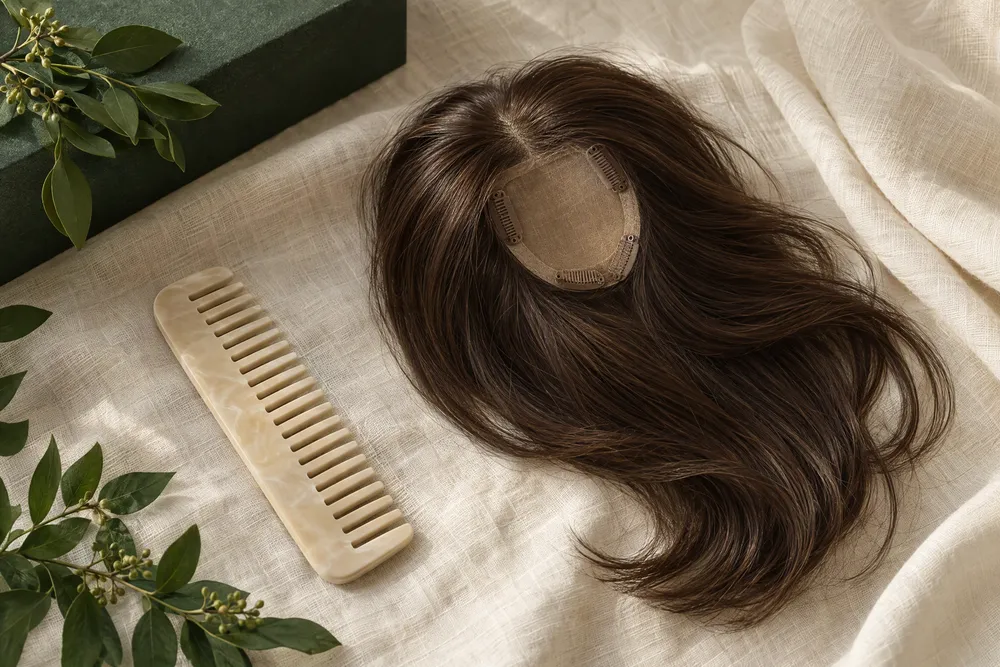
The visible join is not necessarily the edge of the base. Topper hair can fall well below that edge, overlapping your own lengths before either set of ends becomes visible.
Separate the base edge from the styling overlap
Look at dry hair with the topper in its normal fitted position. Identify the crown area it covers, the lower edge of its hanging hair, and the natural sections visible at each side and behind your shoulders. A long overlap may hide the first bend in your own hair; a short overlap may expose it clearly.
Use the hair topper base size guide when coverage itself is uncertain. Moving the piece simply to hide a texture mismatch can change its coverage and attachment position. Establish the fit before deciding where a wave should begin.
Give hair condition priority over the photograph
A hair perm enquiry should first ask whether the intended natural sections are suitable for chemical change at all. Vit So's page discusses present length and previous treatments before agreeing scope. A beautiful overlap plan cannot override unsuitable hair condition, and a photograph cannot settle that assessment.
Choose the first visible bend, not just a curl size
A smooth upper section followed by movement near the collarbone reads differently from a bend opening beside the cheek. The useful reference point is where the viewer first sees movement in the combined hairstyle.
Compare cheek, ear and shoulder landmarks
If the topper falls smoothly beside your face, a lower natural-hair wave may continue that quiet upper outline. If its own lengths already have movement higher up, leaving a long straight gap underneath may look disconnected. Neither arrangement requires identical curls; look for a coherent direction and gradual change in width.
Consider a women's perm discussion as a question about the everyday finish: where should movement first appear when you wear the topper, and what shape do you want without it? Explain whether you normally leave the sides loose, tuck them behind glasses or tie the lower lengths back.
Check fullness at the overlap before adding more
Where topper lengths and natural waves overlap, both contribute to the silhouette. A smooth crown can still meet a bulky band around the ears if the natural bend opens there. Conversely, very fine lower lengths may remain visually sparse beneath a fuller piece. Review hair topper density match rather than assuming stronger waves will solve every fullness mismatch.
- Take front, side and back photographs with the hair dry and sitting normally; keep the same parting for each view.
- Mark the first visible bend and the widest point on each photograph, using ear, jaw and shoulder landmarks.
- Compare a loose-hair view with your usual tucked or tied style; note which natural sections become newly visible.

Consider selected exposed areas only when the boundary makes sense
Changing selected natural sections may fit a narrow visual problem, such as straight lower lengths beneath a piece whose existing movement you like. It still needs a plan for the connection to untreated hair.
Describe the selected sections precisely
For a partial perm enquiry, show the exposed sides or lower lengths you want assessed and identify what must remain unchanged. Vit So lists this scope, but its page does not confirm that every localised technique is available. Ask whether your proposed boundary is workable, rather than treating 'partial' as an instruction to curl any small patch.
Changing the parting can expose untreated neighbours. Check the boundary when turning your head, not just in an arranged front view.
Do not rank safety by the amount of hair treated
The exposed ends may be the very sections with old bleach or repeated straightening. Treating fewer sections does not make those particular fibres suitable. Ask which areas would be excluded, whether previously treated lengths would be involved, and what non-chemical alternative remains if the requested change is declined.
Compare a full natural-hair change with the topper on and off
A whole-head design becomes relevant when you want movement throughout your own hairstyle, including the days or evenings when you do not wear the piece. It should not be chosen simply because it sounds more complete.
Ask what happens beneath the covered crown
A full head perm discussion concerns the natural hair across the agreed scope, not the hairpiece. Ask how the proposed shape in covered areas would sit beneath your existing fit. Extra movement near the crown may change the outline you see with the piece on, even if those natural strands are not directly visible.
Clarify what should remain smoother and how upper and lower areas connect. Establish whether cutting is included in the quotation; a service name alone does not settle that.
Protect the useful dry length
A waving length can appear shorter than the same length hanging straight. Tell the stylist where the dry ends must reach for tying back and for blending beneath the topper. If the piece ends near the shoulders, losing too much visible natural length may create a new outline mismatch that curl similarity does not fix.

Keep natural hair unchanged and compare a closer-textured piece
The third route is to reduce the mismatch at selection stage. This deserves equal attention when your natural texture already suits your routine or chemical change is not appropriate.
Match the overlap rather than chasing a label
Compare available pieces by the first bend, the width through the sides, and the ends that overlap your own hair. Labels such as wavy or curly are too broad to establish a match. A piece with stronger movement but the wrong length may connect less well than a gentler texture with a more suitable falling line.
When considering a synthetic hair topper, ask about its existing texture and product-specific care requirements. Do not assume a general salon perm can change fibre hair. Compare what is actually available, including coverage and attachment, rather than promising yourself a later chemical correction.
Budget for a change of piece, not just a treatment
A new purchase, different base or unfamiliar care routine is a real trade-off. Request available samples or product information and check that the proposed piece still provides the coverage you need.
Record treatment history by section and keep care instructions separate
Current colour does not reveal everything that has happened to the lengths. A darker finish can sit over previously lightened hair, while newer roots have a different history.
Bring an area-by-area history
List approximate dates of colouring, bleaching, straightening and previous perms, including home treatments. Identify which lengths remain from each process and mention new breakage or scalp discomfort. If you cannot recall a product, say that openly instead of describing the hair as untreated.
The American Academy of Dermatology's colouring and perming guidance notes that appearance-enhancing treatments can leave hair dry and brittle. It advises immediate rinsing and dermatological advice for excessive stinging or burning during perming. Tell the stylist immediately if that occurs; tolerating discomfort is not part of achieving a better blend.
Plan two routines where necessary
For natural hair, AAD's healthy-hair advice supports conditioner after washing, gentle handling and limiting heat. Repeated hot-tool work to force a match is not a consequence-free substitute for a chemical decision. Ask for a manageable natural-hair routine suited to the chosen finish.
The topper needs its own product instructions. Our human hair vs synthetic wig care guide helps organise that distinction; natural-hair advice is not permission to use the same products, heat settings or chemical treatment on a hairpiece.
Turn the comparison into one clear consultation brief
Bring a preferred route and an acceptable alternative. That makes it easier to discuss the actual mismatch without committing to chemical work before assessment.
Use a hypothetical decision example
Imagine a smooth shoulder-length topper above previously lightened natural ends. This is a hypothetical example, not a client result. Selected work depends on those ends’ suitability; full change needs a whole-hairstyle goal. Keeping natural hair unchanged and comparing another piece remains a distinct option.
Send fitting and natural-hair questions to the right place
For hair topper fitting Hong Kong, ask OWNSTRAND about coverage, the overlap and available sample options. Send natural-hair chemical suitability questions separately to Vit So. Agree the treated areas, included work and quotation before confirming an appointment.
The brands share an owner but are at different locations. OWNSTRAND is at Room 2103, 50 Hoi Yuen Road, Kwun Tong, WhatsApp +852 5933 4697. Vit So is at 252 Hollywood Road, Sheung Wan, WhatsApp +852 5305 7561. Neither address is a branch of the other.
- Send dry photographs with and without the topper, plus one side view showing the overlap.
- State where the first visible bend should start, where fullness is unwanted, and the dry length you need to retain.
- Attach the natural-hair treatment history and ask which areas can be assessed, including the possibility of postponing change.
- Confirm the appointment, scope, included work and any communication needs before travelling.
| Route | Useful question | Trade-off to check |
|---|---|---|
| Selected exposed natural areas | Can the visible sections connect with untreated neighbours? | A clear boundary is needed; exposed ends may have the most treatment history. |
| Whole natural-hair design | Do you want the new shape with the topper off as well as on? | Covered-area movement and apparent dry length may alter the existing fit and outline. |
| Closer-textured hairpiece | Can an available piece match the overlap without changing natural hair? | Check purchase cost, base coverage, attachment and product-specific care together. |
Ask OWNSTRAND about selection and fitting
Tell us the style you have in mind. We can discuss the options, quotation and arrangements before you decide.
Ask OWNSTRAND about selection and fittingBefore you choose
Must the topper and natural hair have identical waves?
No. A gradual change in movement can work visually even when the waves are not identical. Compare their direction, the width at the overlap and where each set of ends falls. A sharply different silhouette may matter more than a small difference in curl size.
Can photographs confirm that a localised change is suitable?
Photographs help explain placement and length, but they cannot establish chemical suitability. The intended natural sections need assessment alongside their treatment history. Do not treat a successful visual mock-up or a small proposed area as approval to proceed.
Does having a human-hair topper make perming it part of this plan?
No. This comparison is limited to natural hair and choosing a hairpiece with a closer existing texture. Human-hair construction does not establish chemical compatibility or a supplier's permission. The linked natural-hair service page does not confirm a topper-perming service.
Further reading
- Coloring and perming tips for healthier-looking hairSupports dryness and brittleness concerns from appearance-enhancing treatments and prompt rinsing and dermatological advice for excessive stinging or burning during perming; does not compare partial and full treatment safety.
- Tips for healthy hairSupports conditioning after washing, gentle handling and limiting heat on natural hair. These recommendations are not product-specific hairpiece instructions.