

1. Name the grey you want to preserve
With a men's hairpiece, some natural side hair may remain visible. Those retained strands are part of the finished style, not automatically a colour problem.
Keep the silver patch, soften its surroundings
Look at each temple separately. You may like the silver above your ears but dislike the abrupt dark shelf sitting above it. Or you may enjoy scattered white strands yet find one concentrated patch too prominent. These are different complaints, and neither necessarily means you want the whole side dyed.
Write one positive instruction before listing dislikes: 'Keep visible silver at both temples.' Then identify the part you would change, such as the heavy top edge or the brightness of one patch. A positive instruction gives a colour or fitting discussion something to preserve, rather than only something to remove.
Do not insist on identical sides unless symmetry matters to you. Natural grey can be uneven. Compare the overall balance with your face, glasses and usual parting before treating a difference between temples as a defect. Deliberate contrast is a preference, not a rule about looking younger or older.
2. Check the transition in the hairstyle you actually wear
A dark hairpiece and silver temples can work together without identical colours. For a useful comparison, wig colour matching starts with the real sample and retained hair, not a shade name on a screen.
Separate colour contrast from a heavy edge
View the fitted piece from the front and both sides with your hair dry and arranged normally. If the dark top forms a dense horizontal line, ask whether its shape or overlap is the concern before changing either colour. A swept-back style can expose a transition that a forward style partly covers.
Inspect the temple at conversational distance as well as close up. The close view identifies strands and edges; the wider view shows whether they dominate your face. Neither view should replace the other. Take comparison photographs in soft daylight and your ordinary indoor light, without a beauty filter.
Keep the styling finish similar between checks. Wet, glossy hair and a dry matte finish are not equivalent references. Also avoid deciding from one flash photograph: it can emphasise pale strands differently from the mirror view you live with. Record the specific boundary you notice instead of concluding that everything is the wrong colour.
- Take a front photograph and a profile of each side with the piece positioned as you normally wear it.
- Mark the grey you want to retain and identify any dark edge you find too heavy.
- Repeat the view in daylight and ordinary indoor light, keeping your hairstyle similar.
- Bring the piece or ask what sample comparison is possible; photographs alone cannot settle a shade match.
3. Consider leaving the natural temple colour unchanged
Keeping the grey is a complete option, not merely what happens when you postpone dyeing. It suits someone whose silver temples feel familiar and whose main concern is how the darker top meets them.
Review length without erasing your reference point
Explain which temple length you normally keep before discussing a trim. Very close sides show more skin between strands; longer sides present more overlapping hair. The visible grey balance can therefore change with length even without chemical colour. Do not assume a shorter cut will necessarily create the softer look you want.
Ask whether the natural side shape and hairpiece outline can be assessed together, and confirm who is responsible for any proposed work. Keep enough of your usual appearance in the reference photographs to show what you liked before the adjustment. A drastic side cut removes that useful comparison.
In a hypothetical decision example, a man likes broad silver temples but dislikes a bulky dark top. He first asks about the outline rather than coverage. If the fitted shape still feels too stark, he then compares palettes. This sequence preserves his preferred grey while testing whether colour was actually the limiting factor.
4. Describe a softer natural-hair effect, not automatic full coverage
Vit So's men's hair colour reference considers depth, reflected tone and the cut you intend to keep. Use it to prepare a natural-hair discussion, not as permission to colour your hairpiece.
Make retaining white strands an explicit requirement
If you want less contrast at the temples, explain whether you mean fewer bright strands, a less concentrated-looking patch, or a slightly different surrounding depth. 'Softer' does not specify a formula. Ask what effect is feasible on your natural hair and how much visible grey the proposed approach might retain.
The men's grey hair coverage discussion addresses a more consistent appearance, which is different from deliberately keeping silver visible. Say clearly if complete concealment is not your goal. Request an explanation of the proposed areas and likely visual change rather than agreeing to a coverage label alone.
There is no universally correct shade or percentage for this combination. Your existing dark strands, previous dye and usual side length affect the assessment. Discuss what you would accept if the first reference is unsuitable. Keeping the grey unchanged is a sensible fallback when a proposed colour plan would remove the feature you value.
5. Revisit the dark hairpiece before committing to darker sides
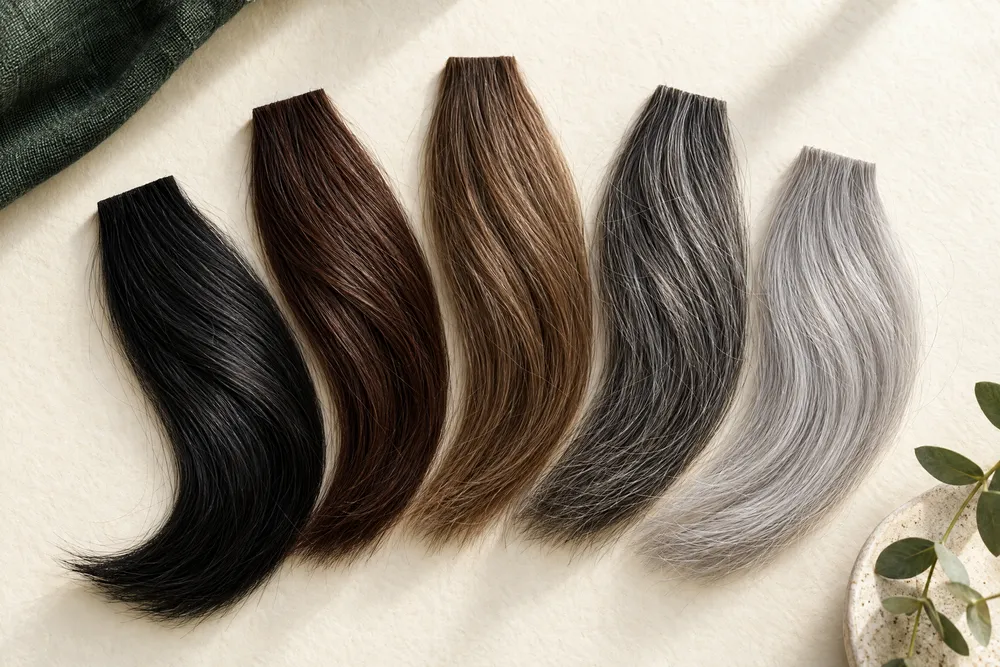
If the temples are the part you already like, compare the top's palette instead. A grey hair system for men discussion can explore visible lighter strands without requiring the entire top to look silver.
Compare overall depth and grey distribution separately
Start by comparing the dark component beside your natural side hair. A slightly different dark depth may feel more connected than your current choice, even without adding grey. Compare available samples rather than assuming every colour name or combination can be supplied.
Then consider whether some lighter strands in the top would suit your preference. custom wig grey percentage is a useful starting point, but a percentage alone does not tell you where pale strands will be visible. Ask how an actual sample looks near the part, front and side transition. Do not assume an exact temple pattern is available.
A hypothetical wearer may prefer to keep a mostly dark top while accepting a few visible greys above it. Another may prefer a plain dark piece and distinct silver temples. Both can be intentional. Your choice should reflect the contrast you enjoy, not an obligation to reproduce the same grey proportion everywhere.
6. Choose an upkeep burden you can actually accept
The best-looking option at a first comparison may not be the option you want to maintain. Think about what changes between haircuts, not only the finished view on one day.
Track regrowth, trimming and reaction history separately
If natural side hair is coloured, new growth and trimming can change the visible balance beside the piece. Ask what would prompt a review: a root boundary, an unwanted reflection or a side cut that exposes more grey. Avoid assuming a fixed appointment interval just because the hair is short.
Before any natural-hair dye service, share previous reactions and current scalp concerns. FDA hair-dye guidance recommends following product directions and skin testing before each use; a negative test does not rule out a later reaction. It also advises against dyeing an irritated, sunburned or damaged scalp.
The NHS information on hair dye reactions describes symptoms such as burning, itching and blisters, which can be delayed. Previous trouble-free colouring is not a reason to omit precautions. Seek medical advice about a reaction rather than treating another shade as a workaround; breathing difficulty or sudden mouth or throat swelling needs urgent medical help.
7. Send two clear briefs rather than assuming one combined service
For natural-hair tinting in the district, the hair colour sheung wan reference explains the colour history and coverage details needed for a Vit So enquiry. It does not establish identical services at OWNSTRAND.
Give each provider the same appearance goal
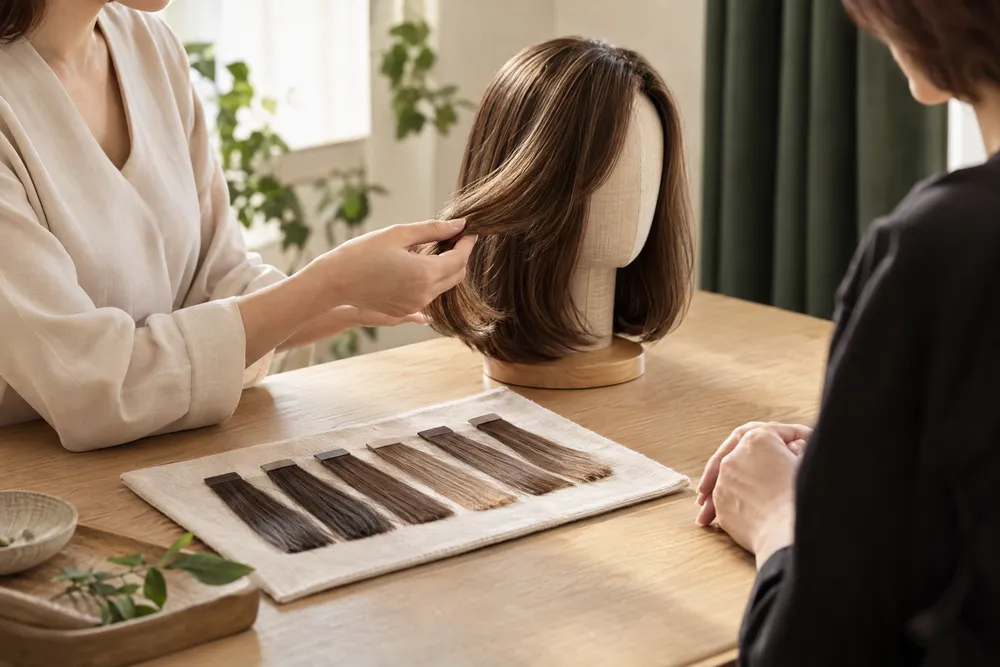
For custom wig consultation Hong Kong, show OWNSTRAND the visible temple hair and the dark top you want to keep. Ask about samples, palette choices and fitting arrangements. OWNSTRAND's Kwun Tong store is at Room 2103, 50 Hoi Yuen Road, Hong Kong; its WhatsApp is +85259334697.
For a separate natural-hair colour enquiry, Vit So is at 252 Hollywood Road, Sheung Wan, Hong Kong; WhatsApp +85253057561. State that you wear a hairpiece and want visible temple grey retained. Confirm the proposed natural-hair scope, quote, preparation and appointment before travelling. Do not assume a shared package, transferable booking or work on the piece itself.
- State the non-negotiable: visible grey should remain at the temples.
- Attach your ordinary front and side views, and identify the contrast you dislike.
- For the hairpiece enquiry, give its material information and ask which samples can be compared.
- For the natural-hair enquiry, list previous treatments and reactions; confirm scope and preparation separately.
| Direction | What you preserve | What to confirm |
|---|---|---|
| Keep natural grey unchanged | Your familiar silver temples | Whether side length or the top outline is the real concern |
| Discuss a softer natural-hair colour effect | Some visible white strands as an explicit goal | Feasible effect, treated areas, precautions and upkeep |
| Revisit the hairpiece palette | Natural temples without adding a dye routine | Available dark depths, grey distribution and sample comparison |
Ask OWNSTRAND about selection and fitting
Tell us the style you have in mind. We can discuss the options, quotation and arrangements before you decide.
Ask OWNSTRAND about selection and fittingBefore you choose
Must the hairpiece contain as much grey as my temples?
No. A darker top with silver temples can be a deliberate choice. Compare the whole outline and available samples rather than prescribing the same grey proportion throughout. If you want a closer connection, ask about depth and the placement of lighter strands as separate questions.
Can I use the same dye on my natural sides and the hairpiece?
Do not assume that is suitable. Natural-hair dye guidance does not establish compatibility with synthetic fibres, blends, processed human hair or a hairpiece base. Give the provider the piece's actual material and care information. This article compares palettes; it does not recommend chemically altering your piece.
Should I choose the hairpiece palette before colouring my sides?
First identify the temple appearance you want to keep, then compare the current piece beside it. If your side colour is satisfactory, reviewing the palette may avoid an unnecessary dye routine. If you choose natural-hair colour, ask how its expected appearance and upkeep should inform a later sample comparison.
Further reading
- Hair Dyes — US Food and Drug AdministrationSupports product directions, skin testing before each use, reactions despite previous uneventful use, the limits of a negative test and avoiding dye on irritated or damaged scalp. Applies to natural-hair dye safety, not hairpiece compatibility.
- Hair dye reactions — NHSSupports recognising burning, itching and blisters, the possibility of delayed symptoms and seeking healthcare help for reactions, including urgent help for severe allergic symptoms.