

Read your waves when they are fully dry
Start with the hair you actually wear, not its stretched length or a freshly arranged photograph. Vit So's guide to a haircut for naturally wavy hair helps you describe that natural-hair baseline before discussing a change to its outline.
Locate the first bend beside each temple
Use your usual wash and drying routine, then let the natural lengths finish drying before comparing them with the fringe. Note where each side first changes direction. Fairly straight roots with waves beginning below the cheeks create a different meeting point from hair that bends immediately beside the eyes.
Check both sides without arranging them into identical shapes. One side may curve towards the cheek while the other turns away. Record that difference, along with your normal parting. Matching only the strongest wave at the back tells you little about the short section nearest the hairpiece.
Keep everyday and styled references separate
Take ordinary front and side photographs, then label any second image that uses a brushed or heat-styled finish. The American Academy of Dermatology's styling advice supports reducing blow-drying frequency and warns that excessive heat can damage natural hair. It is a reason to understand your lower-effort baseline, not a heat guide for a fibre fringe.
Check the temple join before the fringe centre
A front photograph can hide the exact place where straight hairpiece ends meet natural waves. Turn slightly sideways and look at that junction first. If the piece is unfamiliar, OWNSTRAND's clip-in bangs guide explains the detachable format before you assess its outline.
Separate a texture difference from a raised edge
Follow the hair from the centre of the fringe towards one temple. Does it descend into the surrounding lengths, stop as a short separate strip, or sit above them? A change from smooth to wavy can be attractive. A visible base edge or a corner standing away from the head is a fitting question, not proof that the waves need removing.
Look at density as well. A solid-looking fringe beside a lightly covered temple can create a sharp boundary even when the colours are similar. Conversely, a lighter fringe can reveal more of the attachment. Neither observation means that cutting more hair away will solve the cause.
Watch the join during your normal movements
Put on your glasses, look down, turn your head and try your usual ear tuck. Check whether a side piece catches on the frame or whether the attachment becomes visible when the natural hair moves. Do not reposition the fringe beyond its intended fitting range to chase a perfect angle. A comfortable position that works from several views matters more than one carefully arranged photograph.

Keep the contrast if you enjoy a distinct front
Blending does not have to mean making every strand the same. A clearly straight fringe against loose waves is one valid design, provided the temple transition is deliberate and the piece fits properly.
Choose what should look separate
Decide whether you like a continuous straight edge across the forehead or a more separated front. Then look at the corners. You might enjoy a defined centre while preferring the side ends to sit close to the natural hair. Judge those details independently instead of rejecting the whole look because the lengths are wavy.
The contrast is easier to evaluate when the surrounding waves are left in their normal position. Pulling them taut for the mirror changes the comparison. You also need to like the result when the hair relaxes again during the day, without repeatedly brushing the sides smooth.
Test the version you can leave alone
For a hypothetical example, imagine loose waves beginning below the cheek and a fringe whose side ends already lie flat near the temple. Keeping the straight front may require fewer changes than replacing it. That is a decision example, not a client result. If the only acceptable version needs constant smoothing, the contrast may not suit your routine even if you like its photograph.
Consider a softly face-framing natural front
If you have enough natural front hair and want less separation at the temples, natural curtain bangs are another option to discuss. That reading concerns natural-hair fringe shape; it does not confirm that Vit So can reshape any detachable hairpiece.
Check the opening without forcing symmetry
A softly face-framing front leaves an opening and longer pieces beside the face. On natural waves, those pieces may curve differently on each side. Assess the dry opening you already have, or the direction of longer front hair, rather than assuming a centre part will hold a polished outward sweep without styling.
You can temporarily move existing long front sections aside to preview more visible forehead. This only previews an opening: it cannot predict how a shorter cut will fall. Do not cut a trial fringe at home to obtain the missing information.
Keep coverage needs in the decision
If your hairpiece supplies coverage you need, a natural curtain shape may not replace its job. Explain that before discussing a cut. Where natural front hair is available, mark the pieces that must still reach your ear tuck or ponytail and ask about their likely dry landing points. Choose the amount of forehead you enjoy seeing; a generic face-shape rule cannot answer these practical questions.
Compare a piece with closer existing waves
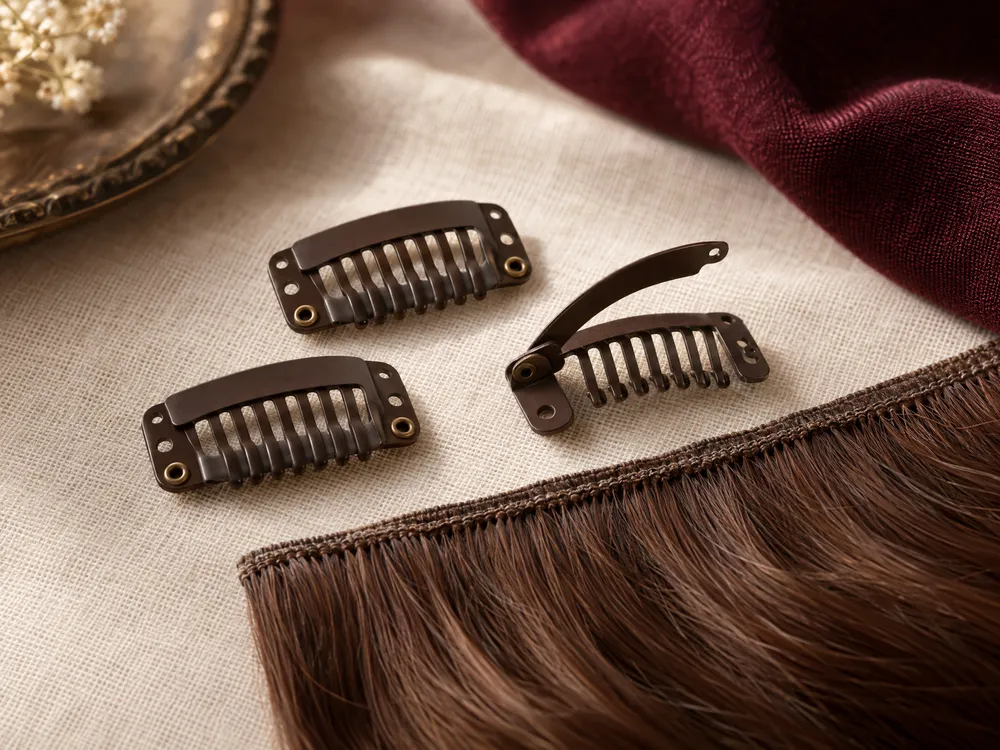
If a smooth fringe feels too separate, compare another piece's existing pattern before restyling the one you own. OWNSTRAND's wavy wigs guide offers useful pattern vocabulary, although a full-wig style does not establish availability of a matching detachable fringe.
Match bend height and direction, not the label
Terms such as loose wave describe broad appearances. Ask where the first bend begins on the candidate piece and which way its side ends turn. A piece with strong bends high at the temples may look less connected to your straight upper lengths than a smoother piece with a gentle turn lower down.
Compare the two materials side by side in ordinary light, looking at colour depth and surface shine after the wave direction. A similar shade does not erase a different bend pattern, and an attractive curl in a product photograph does not reveal the fitting position on your head.
Do not demand a strand-for-strand match
Aim for a compatible transition across the small visible area beside the face. Some natural variation can remain. Request clear front and side views and ask whether the displayed pattern is the supplied style or an additional styled finish. If suitable samples are unavailable, pause rather than buying a straight piece on the assumption that someone can safely add the required wave later.
Rehearse the join without heat or permanent changes
A reversible rehearsal helps identify what is actually awkward. Its purpose is to compare placement and outlines, not to mould a new wave into the piece.
Keep the materials separate during preparation
Prepare the natural lengths using your normal routine. Handle the detached fringe only as its own instructions permit, then fit it in the intended position. Do not wet, steam or wrap the piece around rollers as an improvised matching method. No heat does not automatically make an alteration appropriate for an unknown material.
Keep the first comparison simple enough to repeat on another ordinary day. Changing your parting, adding unfamiliar products and pulling the sides into a new direction together makes it hard to identify which change helped.
- Photograph fully dry natural hair first, keeping your everyday parting and relaxed waves.
- Fit the unaltered fringe according to its attachment instructions; stop if it pulls or feels insecure.
- Compare each temple at rest, then with glasses, head turns and your normal ear tuck.
- Move only freely available natural side hair to preview a softer transition; do not drag clips or stretch waves flat.
- Record one preferred arrangement and one remaining problem, such as a raised corner or an abrupt texture change.
Ask about material before discussing restyling
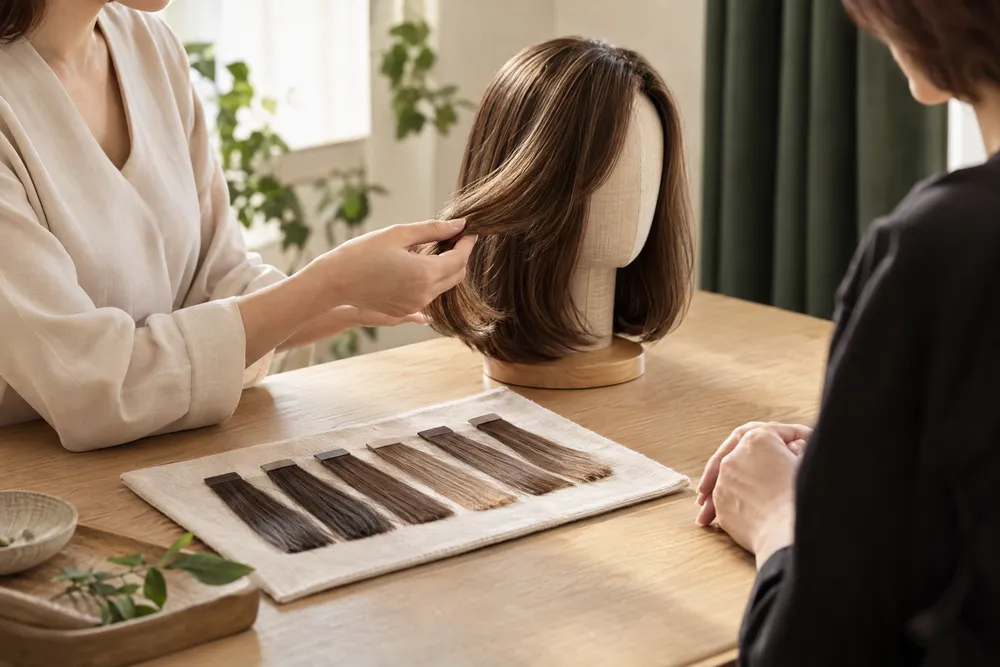
The same visual problem can require different handling for different materials. Review human hair vs synthetic wigs to identify the category, then obtain the instructions for your exact piece.
Confirm what the whole piece permits
The Breastcancer.org fibre overview distinguishes standard synthetic, heat-friendly synthetic, mixed and human-hair wigs. Ordinary synthetic is not made for curling or straightening with heat tools. Heat-friendly material still has limits; the label is not permission to use a natural-hair routine.
For a labelled heat-friendly piece, OWNSTRAND's heat friendly synthetic wig care provides preparation questions. Do not borrow temperatures or cutting methods from natural-hair advice. Human hair in a piece also does not establish that its base, attachment and previous processing permit the proposed change.
Send a focused enquiry to the right business
For OWNSTRAND selection and fitting enquiries, send the piece label, dry natural-hair views and your temple-join observations. OWNSTRAND is in /en-hk/; WhatsApp +852 5933 4697. Ask what can be assessed rather than assuming a modification service for a third-party piece.
Vit So's linked guides support a separate natural-hair discussion. Vit So is at 252 Hollywood Road, Sheung Wan, with contact +852 5305 7561, not an OWNSTRAND branch. Confirm the scope and availability of any proposed natural-hair appointment.
- What is the exact fibre composition, and where are the maker's care instructions?
- Does this model explicitly permit the proposed heat, wet setting or other restyling method?
- What restrictions apply to its base and attachment, not just its strands?
- If trimming is proposed, who has confirmed compatibility with this piece and the fitted outline?
- Would a different supplied pattern solve the join with fewer irreversible changes?
| Approach | Inspect when dry | Main trade-off |
|---|---|---|
| Keep deliberate straight/wavy contrast | Fringe corners, attachment edge and the first natural bend | Preserves the piece; requires liking a visibly separate front |
| Discuss a natural face-framing curtain shape | Available front hair, natural opening and side landing points | May connect the natural texture, but may not supply needed coverage or tuck length |
| Compare a piece with closer existing waves | Bend onset, direction, density and supplied finish | May reduce texture separation; suitable pattern and fit are not guaranteed |
Ask OWNSTRAND about selection and fitting
Tell us the style you have in mind. We can discuss the options, quotation and arrangements before you decide.
Ask OWNSTRAND about selection and fittingBefore you choose
Must I straighten my natural waves to wear a straight fringe?
No. Decide whether you enjoy a distinct smooth front, then check the temple joins in your ordinary dry hair. Straightening the lengths changes the comparison and adds another routine; it is not a prerequisite for wearing the piece.
Can I cut the hairpiece corners to make them blend?
Do not use a natural-hair trimming tutorial as instructions for the piece. First establish whether the concern is fit, density, length or direction. Confirm its material and construction, then ask someone who can assess that exact piece whether alteration is appropriate. Shortening cannot be undone.
Why does the fringe look connected in front but separate from the side?
The front view may conceal a raised base edge, short corner or abrupt change in bend direction. Photograph both temples in the intended fitting position and check them after moving. Identify the visible cause before deciding whether you need different placement, another piece or a natural-hair discussion.
Further reading
- Hair styling without damage — American Academy of DermatologySupports reducing blow-drying frequency and the caution that excessive heat can damage natural hair. Not used as instructions or temperature limits for hairpiece fibres.
- Synthetic vs Human Hair Wigs: Which Fiber Type Is Right for You? — Breastcancer.orgGeneral distinction between standard synthetic, heat-friendly synthetic, blends and human hair. Supports checking fibre-specific restrictions, not a universal restyling protocol, stock claim or promised match.