

Map three areas, even when you call it two textures
Natural hair has new growth and older treated lengths; the removable piece is a third area. Compare straight wigs as a separate style choice.
Find the contrast without testing the hair's strength
Look after your normal wash and drying routine. Notice where curls flatten into previously straightened hair at the fringe, crown and back; the boundary may be uneven. Do not stretch strands to find it or repeatedly iron roots to make the comparison easier.
Record the last straightening service and any later bleach, highlights or home colour. Older processing can remain in the ends when roots look natural. If the product is unknown, say so; an appointment record is more useful than guessing from the finish.
Name the problem you need to solve today
Choose a priority: piece comfort, easier detangling or a coherent exposed outline. A straight wig is a styling option, not a target every natural strand must match.
- Take front, side and back photographs without adding a special smoothing finish.
- Record the approximate transition area and known service history, without treating the record as a chemical application map.
- Photograph the piece separately and note its stated material and care instructions.
Decide how much natural hair must blend with the piece
Coverage changes the task. The comparison in hair topper vs wig is useful here because a full covering and a partial crown piece leave different amounts of your own hair visible.
A full wig prioritises fit rather than identical texture
If your natural lengths stay underneath, their straightness need not match the wig. Arrange them gently and check for a bulky area or an uncomfortable pull under the cap. Ask about fitting if the usual arrangement no longer feels comfortable as regrowth becomes fuller. Pulling everything tightly flat is not a substitute for that discussion.
A topper makes the exposed join more important
With a straight topper, look at the hair beside the base and below its lengths. The issue may be a sudden change in width rather than a difference in curl everywhere. Our guide to how to blend a hair topper with natural hair offers a separate starting point for discussing that visible join.
Check your side view and usual ear tuck, not only a still front photograph. If blending takes too much daily effort, discuss coverage or style options before changing your natural hair. A different piece is not a guaranteed solution or a reason to sacrifice useful length.

Continue the grow-out without making every day a straight-hair day
If you are considering stopping further processing, Vit So's discussion of hair straightening for naturally curly hair explains the regrowth commitment. For an existing transition, the useful question is how to live with the contrast while deciding what length to retain.
Choose an interim shape you can repeat
Keeping two textures can preserve length while the natural section grows. Consider a loose tied-back arrangement on non-wig days or accepting more root fullness with straighter ends. Choose a routine within your morning time; one polished finish achieved with extensive tools does not prove it is easily repeatable.
Stopping appointments does not necessarily return the original curl to previously treated lengths. Growing and gradually trimming may therefore be part of the plan. There is no universal deadline: your preferred length, visible contrast and tolerance for upkeep determine what you want to discuss.
Ask about shape management before another process
Tell a natural-hair stylist which ends you could lose and what must remain for tying back. Show the dry outline with the piece off, then the exposed join when it is on. Cutting may alter the silhouette without making both textures identical. Removing too much length can also remove hair you need for your usual arrangement, so agree on that trade-off before scissors are used.
Build separate natural-hair and wig-care routines
A texture contrast does not call for extra force. The American Academy of Dermatology's curly-hair guidance supports sectioned detangling of wetted, conditioned natural curls and warns against dry brushing them.
Avoid one long tug through the transition
Work gently in manageable sections and stop when a knot resists. Fingers or a wide-toothed comb can help with conditioned natural curls; straighter treated lengths need their own handling assessment. Do not drag a brush root to tip because the ends look smooth. Ask for help if detangling remains difficult.
AAD's hair-damage advice recommends conditioner after shampooing, absorbing water without towel rubbing and reducing heat-tool use. On your own hair, avoid turning daily root ironing into the default way to hide every new bend. Follow any procedure-specific restrictions already given by your salon.
A straight piece is not chemically identical to straightened roots
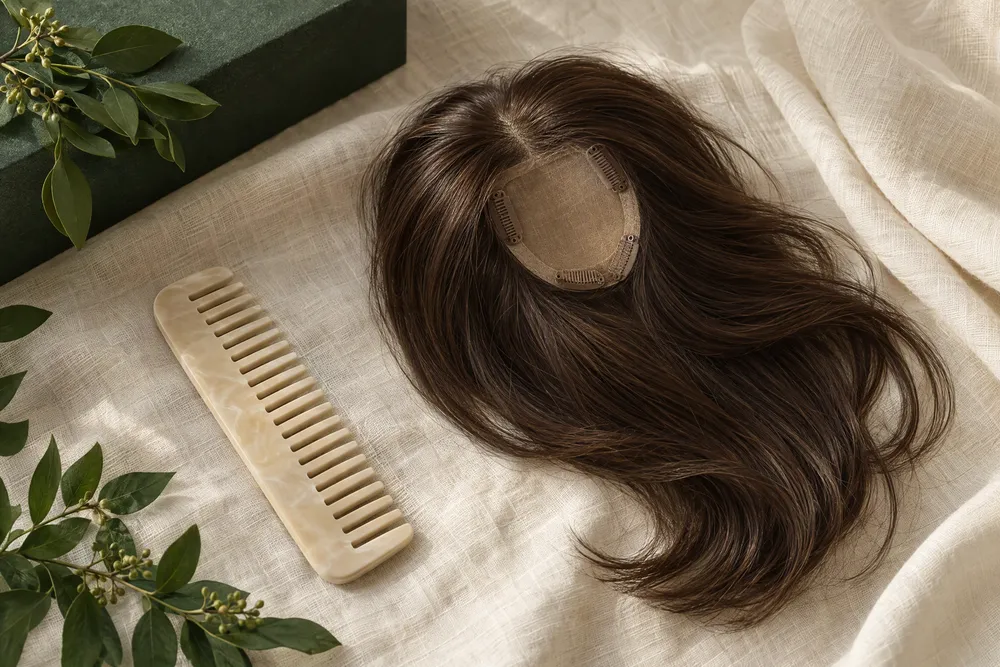
Use the piece's material and construction instructions. The distinction in human hair vs synthetic wig care matters even when both look straight. Natural-hair advice about wet detangling or conditioner placement cannot simply be transferred to fibres, attachment areas or knots. Human hair in a wig also has its own processing history and base; it is not permission for another chemical service.
If you enquire about another service, identify what stays untouched
Vit So's hair straightening service page asks readers to describe roots, middle lengths and ends separately. In a grow-out enquiry, make the already treated section explicit instead of requesting the same work over everything.
A service label cannot define the regrowth boundary
If you ask about ionic straightening, explain that this is a suitability question about your natural hair. Ask which area would be considered and how earlier treated lengths would be accounted for. The listed name does not confirm a regrowth-only service, a method for your particular history or a blended result.
Also describe movement you want to keep, including root lift. Ask whether a cut, a drying adjustment or postponing further processing better serves the goal. If the assessment does not support more work, a clear alternative is more helpful than asking for a stronger process.
Bring the piece into the style discussion, not the chemical plan
A photograph of the piece can show the outline you like, not how your natural hair will behave after treatment. It cannot establish that the salon can chemically alter the wig. Keep those questions separate: no natural-hair listing confirms a service for your particular hairpiece.
- State which natural lengths were previously straightened and disclose other processing still present.
- Ask what assessment is needed, which area is proposed and what alternatives are available.
- Confirm the actual product, procedure and aftercare before agreeing; do not infer them from a label.
Read the price as a scope question, not a maintenance instruction
The hair straightening price reading is useful only after you have described the grow-out and desired work. A published entry does not tell you that another treatment is needed or that the wig should be straightened.
Ask what the quote actually covers
Confirm the assessed area, washing, any haircut, finishing and applicable length charge. If you want a limited-area service, ask whether it is available and appropriate; do not divide a full-service amount by the visible length of regrowth. A colour root-touch-up entry is not a straightening retouch tariff.
Compare daily upkeep alongside the charge. A grow-out may involve extra detangling or an interim cut; further assessed work involves appointment time and care requirements. Neither guarantees a perfect topper join. Explain your daily effort limit.
Make the alternative concrete
In a hypothetical example, a full-wig wearer dislikes their natural-hair outline only on weekends, so first discusses an interim cut. A topper wearer with exposed curly sides has a different blending question. Neither example establishes a service recommendation or result.

Review the transition after ordinary wear, not constant styling
Record root fullness, tangling in older lengths and piece movement separately; each may need a different next step.
Keep the two routines visible
Record whether the natural-hair concern appeared after washing, tying back or wearing the cap. For the removable piece, follow the separate guidance on how to wash a wig and its own instructions. Do not synchronise both wash routines merely because they are worn together.
Persistent scalp discomfort or unexplained hair loss calls for medical advice, not stronger processing. A piece-fitting discussion does not diagnose a scalp condition.
Send the right question to the right location
For OWNSTRAND selection and fitting enquiries, contact the Kwun Tong store at Room 2103, 50 Hoi Yuen Road, Hong Kong, via WhatsApp +852 5933 4697. Describe your piece and how much natural hair remains visible.
Vit So's separate natural-hair service location is 252 Hollywood Road, Sheung Wan, Hong Kong, with contact +852 5305 7561. Share the grow-out history and ask about assessed scope. It is not an OWNSTRAND branch, and an enquiry does not confirm either suitability or an appointment.
| Route | What it preserves | Trade-off to discuss |
|---|---|---|
| Continue the transition | New natural texture and current length | Mixed outlines remain; choose a gentle routine and an interim arrangement. |
| Discuss natural-hair shape management | Some length without automatically adding chemical work | A cut changes the silhouette, not necessarily the texture; retain needed tie-back length. |
| Enquire about further assessed straightening | A possible change to specified natural-hair areas | Suitability, old/new boundaries, retained movement and care must be established first. |
| Reconsider piece coverage or style | A separate visible look without requiring identical roots | Fit and exposed joins still need checking; availability and compatibility are not assumed. |
Ask OWNSTRAND about selection and fitting
Tell us the style you have in mind. We can discuss the options, quotation and arrangements before you decide.
Ask OWNSTRAND about selection and fittingBefore you choose
Will stopping straightening make the older lengths curly again?
Do not assume that the treated lengths will regain their original pattern. New growth can retain your natural curls while older hair stays straighter. Discuss an interim shape and gradual trimming if you want to grow out those lengths, rather than expecting a conditioner to reverse the change.
Must I straighten the exposed hair to wear a straight topper?
No. First check where the textures meet and how much mismatch bothers you during ordinary wear. Compare length, density, coverage and daily styling effort in a fitting discussion. Straightening is one separate natural-hair enquiry, not a requirement established by wearing a topper.
Can a cheaper regrowth quote tell me it is safe to proceed?
No. Price describes agreed work, not suitability. A limited-area service must be confirmed rather than inferred from the full-service listing. Share the older processing and ask how it affects the proposed scope; the quote also says nothing about chemical work on your wig.
Further reading
- 6 curly hair care tips from dermatologistsSupports gentle sectioned detangling of wetted, conditioned natural curls and avoiding dry brushing; not a wig-care or chemical-service protocol.
- 10 hair care habits that can damage your hairSupports conditioning, gentle towel handling, reduced hot-tool use and avoiding pulling; recommends dermatology advice for unresolved concerns about thinning or hair loss.