
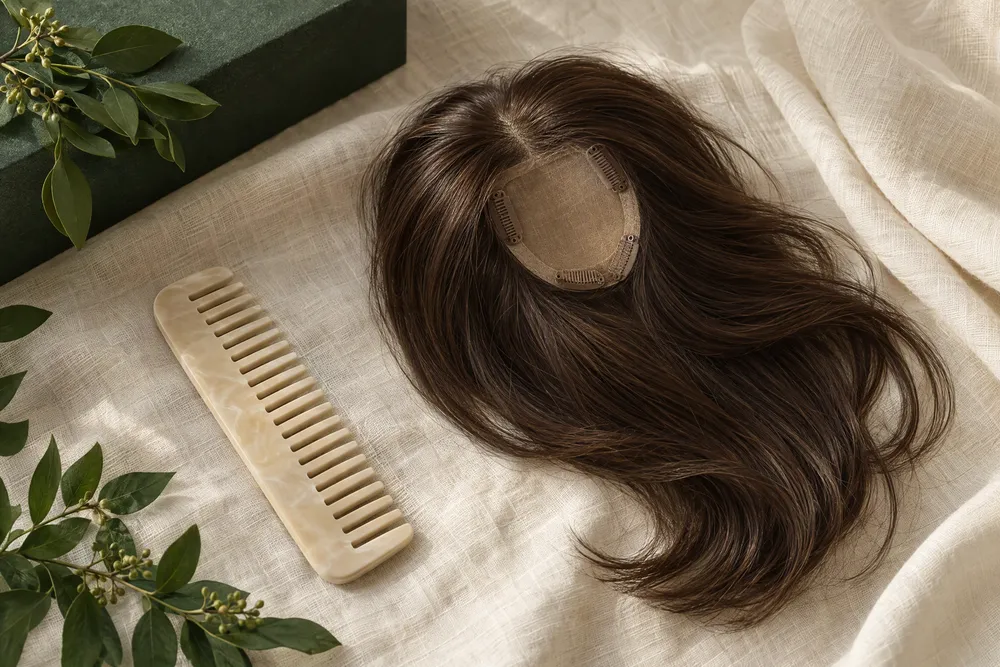
Locate the exposed hair before deciding it needs hiding
Start with what remains outside the coverage area. OWNSTRAND's guide to hair toppers explains partial coverage; the natural lengths below that area still contribute to the finished shape.
Distinguish the base edge from the falling hair
The base sits on the head; the topper's hair may fall well beyond it. A shelf halfway down the hairstyle is not necessarily an exposed base. It could be topper ends, natural layers, or several sections meeting at a similar height.
With the piece removed, note where your natural layers finish. With it fitted as intended, compare those areas without pulling the ends down. If you cannot identify which hair creates the line, record its location for the fitting discussion rather than repeatedly repositioning the piece.
Keep coverage and silhouette questions separate
The hair topper base size guide concerns coverage and fit. The lower outline concerns hair falling beyond that area. A larger base is not automatically a solution to an unwanted length step, and more crown hair does not necessarily resolve broad shoulder-level ends.
Draw front, side and back outlines on one sheet
A sketch removes distracting details and helps you say exactly where the outline changes. Drawing skill is unimportant: use a head shape, two shoulder marks and a few lines showing resting ends.
Give each view a different job
For the front sketch, add the hair's outer contours to a face oval. Mark visible ends beside the jaw and collarbone. Circle a shelf only where several ends gather; distinguish isolated face-framing pieces from a broad side-length step.
For the side sketch, draw a profile, an ear and one shoulder. Trace crown to nape, marking widening behind the ear and the gap between short side ends and long back ends. Keep your chin level while observing.
On the back sketch, trace both outer sides down to the perimeter beneath an oval and two shoulders. Mark a repeated shelf horizontally, but use separate short strokes for loose ends. Describe the current outline; do not draw a cutting plan.
- Observe the dry hair in its ordinary parting and fitted position; label the sheet with those conditions.
- Make all three sketches before choosing the feature that concerns you most.
- Use T for ends you can identify as topper hair, N for natural hair and a question mark where you are unsure.
- Circle one boundary to discuss and write one feature you want preserved, such as the fuller lower edge.
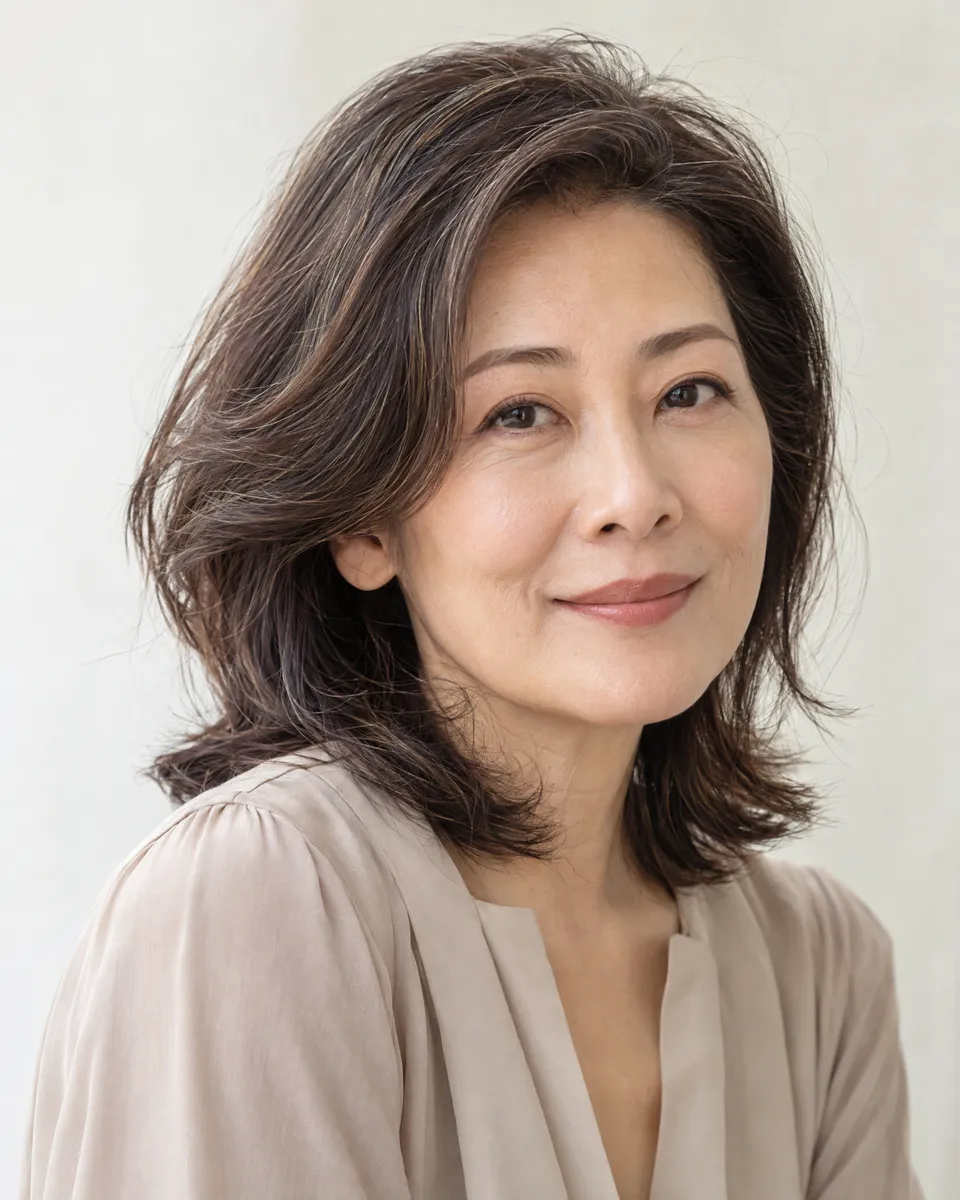
Recognise a clear length step without chasing every short piece
A natural-hair layered haircut reference can help separate the shortest pieces from the retained perimeter. Use that distinction to explain your exposed natural hair, not as permission to cut the topper yourself.
Look for a line that repeats across a zone
A clear step is more than one short strand. Several ends appear to stop at a similar level while a longer section continues beneath them. In your front sketch, it might look like a broad shelf beside both jaws. In the back sketch, it might cross the upper part of a longer outline. The side view shows whether that shelf connects around the head or belongs to one area.
Let the hair settle after a normal head turn. Note whether the line returns or only appears when a section is moved forward. Record that distinction rather than assuming a permanent mismatch.
Decide which length deserves protection
Imagine a hypothetical wearer with natural hair below the collarbone and an upper section ending near the jaw. She likes her long outline but dislikes the jaw-level shelf. Her brief should protect the lower length and identify the shelf, not shorten everything to it.
Read lower fullness as a width problem, not only a length problem
A combined hairstyle can have compatible lengths and still feel disproportionately full below the ears. OWNSTRAND's guide to how to blend a hair topper with natural hair provides the broader blending context; here, isolate the width of the exposed outline.
Find where the contour first widens
Follow the sketched contours downwards. Do they widen gradually, expand behind the ears or spread at the shoulders? Compare the natural hair alone: existing lower width is a different starting point from extra breadth created by overlapping topper and natural lengths.
Fullness is not inherently undesirable. A substantial lower edge may be the point of the hairstyle. The useful concern is whether the width competes with the upper shape you want, or makes a pronounced change that you did not intend. Avoid calling every dense lower section excessive.
Describe the area rather than prescribing thinning
Say, 'I like the full bottom edge, but this area behind the ears looks too wide.' That protects the valued feature. Asking for general thinning does not. Discuss overlap, the existing natural cut and piece suitability rather than prescribing a cutting technique.

Allow intentional separation to remain part of the design
A natural-hair wolf cut reference is useful for discussing short upper areas, a longer back and visible separation. Those features can be intentional rather than signs that every exposed layer must disappear.
Compare scattered ends with a continuous shelf
Separated texture usually asks you to notice individual pieces and their different resting points. In a sketch, show several short strokes instead of one solid horizontal boundary. Check the side view: a deliberately longer back can be easier to recognise there than from the front. Decide whether that contrast is something you want to keep.
A wearer might enjoy separated natural side pieces but find the topper's upper section too smooth against them. That relationship does not make the natural texture wrong. Identify the upper-to-lower contrast you prefer before requesting a change.
Do not confuse a styled reference with everyday fall
A reference photograph may arrange waves and ends more distinctly than your ordinary drying routine does. Choose which part you actually want: the longer back, the scattered perimeter or the lift above it. If preserving visible natural texture matters more than a uniform outline, state that explicitly. Smoothing every piece into the topper's fall could remove the character that attracted you.
Check shoulder contact before changing medium-length layers
References for medium length haircuts for women explain why shoulder and collarbone landing points need individual attention. An outward turn where the hair meets your shoulder is not the same observation as an upper length step.
Record resting position and contact separately
Look at the hair resting forward, then behind the shoulders. On the side sketch, add a small contact mark where the ends meet the shoulder or an ordinary collar. Note whether a wider bottom outline appears in that position but eases when the hair falls forward. That gives a more useful description than assuming the layers are too short.
For a hypothetical wearer with shoulder-level natural ends, a jacket collar might lift one side while longer topper ends fall beyond it. Identify those different landing points first; changing internal natural layers is not automatically the answer to perimeter contact.
Choose a shape that does not demand repeated correction
The American Academy of Dermatology's styling guidance recommends keeping brushing to a minimum, allowing partial air-drying and reducing blow-drying frequency. Apply that advice to your retained natural hair instead of repeatedly brushing and heating it to erase the outline. The topper has its own material-specific care requirements; this guidance does not establish its heat tolerance.
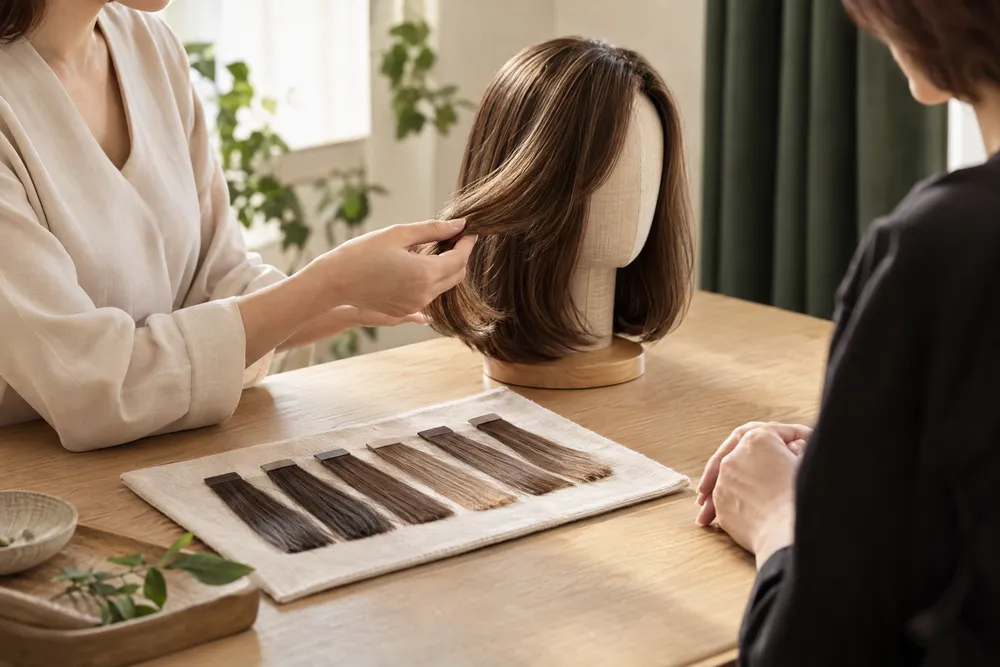
Take one boundary and one protected feature into the consultation
Your three sketches should produce a specific request, not a list of everything that looks different. If the overall approach feels unsuitable, the hair topper vs wig comparison can help you reconsider coverage without assuming a cut will solve every mismatch.
Turn the observation into a usable brief
Try: 'The back shows a repeated upper shelf, but I want to keep the fuller natural ends.' Or: 'Keep the separated sides; discuss the width behind my ears.' Bring ordinary photographs from all three angles to supplement your sketches.
For an OWNSTRAND hair topper consultation Hong Kong enquiry, explain whether you already own the piece or are comparing options. Ask which fitting or alteration questions can be assessed for that actual item before assuming work is available.
Separate the natural-hair service from work on the piece
The linked Vit So articles support a natural-hair cutting discussion. They do not establish that Vit So will modify any topper. Confirm the object to be worked on, the proposed scope and the charge separately. OWNSTRAND and Vit So have common ownership but separate service locations; these links are not independent testimonials.
- Lead with the circled boundary and show the view where it is clearest.
- Name the length, fullness or separated texture that must remain.
- Ask which visible ends belong to the piece and which belong to your natural hair.
- Confirm any natural-hair cutting and any proposed piece work separately before agreeing.
| Visible pattern | Sketch clue | Discussion priority |
|---|---|---|
| Clear length step | Several ends form a repeated shelf above longer hair; compare all three views. | Identify the hair creating the shelf and protect the preferred lower length. |
| Overly full lower outline | The contour broadens behind the ears or across the lower section without a clear shelf. | Locate the unwanted width while stating how much bottom-edge fullness you want retained. |
| Intentional separated texture | Individual end marks sit at different heights, with a deliberately longer back. | Keep the desired separation; isolate any additional boundary that feels unintended. |
| Shoulder-contact turn | The side sketch shows ends turning where they meet the shoulder or collar. | Discuss landing points and everyday position before changing internal layers. |
Ask OWNSTRAND about selection and fitting
Tell us the style you have in mind. We can discuss the options, quotation and arrangements before you decide.
Ask OWNSTRAND about selection and fittingBefore you choose
Does visible natural hair below the topper always mean it is too short?
No. Exposed natural hair is part of partial coverage, and visible layers may be intentional. A repeated shelf, unwanted width or undesired texture contrast is more specific than simply seeing natural ends. Compare all three views before blaming length.
Should I remove the topper before a natural-hair haircut?
Agree on the assessment and cutting sequence with the professional. The natural cut and the combined outline may both need inspecting, but that does not mean the piece should be cut while you wear it. Bring the actual item if requested and confirm which hair will be worked on before the service starts.
What if I like the front but dislike the back outline?
Keep the front as a protected feature and use the back sketch to identify the separate concern. Ask whether it is a repeated length shelf, insufficient or excessive lower fullness, or a deliberate long-back contrast you no longer want. One satisfactory angle does not require changing every other section to match it.
Further reading
- Hair styling without damage — American Academy of DermatologySupports limited brushing, partial air-drying and reduced blow-drying frequency for retained natural hair. It does not validate a topper-blending result or the heat tolerance of a hairpiece.